Semantic Band-Gap (LLM + KG)
A neuro-symbolic pipeline for symmetry-aware materials screening.
Multi-constraint questions in materials science are rarely blocked by a
single missing number — they are blocked by constraints living in
different formats. Finding a candidate for ultraviolet frequency
doubling, for instance, requires a non-centrosymmetric crystal (even-order
nonlinear response vanishes identically under inversion symmetry — a
selection rule, not a tendency) and a wide band gap. Symmetry
comes from the crystal structure, the gap from an electronic-structure
calculation, composition from a formula string. Here that is one
question: "non-centrosymmetric materials with band gap above
2.5 eV" returns 9,429 candidates from 150,987, provenance attached.
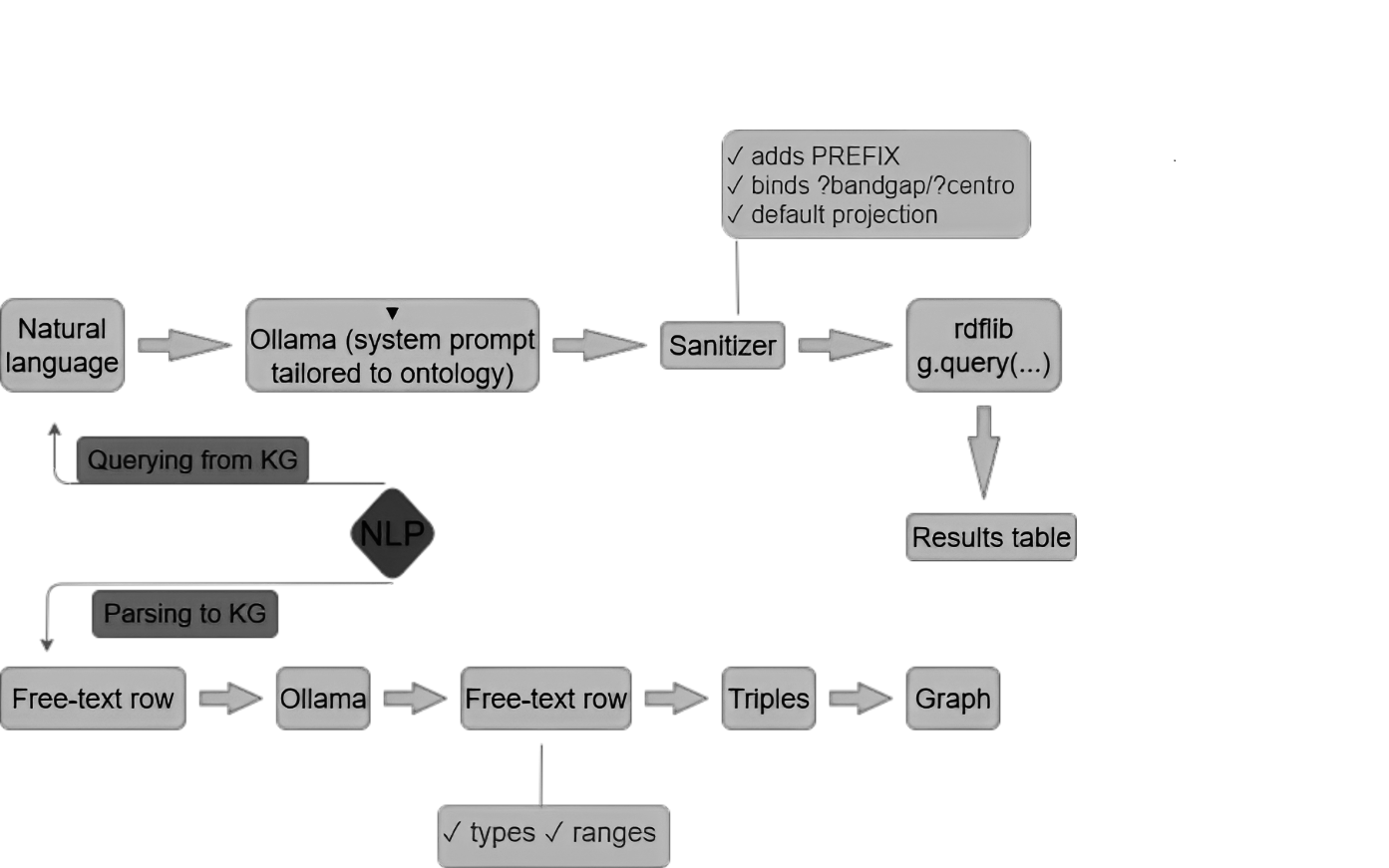
Two LoRA adapters fine-tuned on Llama 3.2 (3B) drive it — one generating
SPARQL from natural language, one extracting deduplicated triples from
unstructured text. A deterministic sanitizer sits between model and
graph, repairing and schema-enforcing every generated query, turning
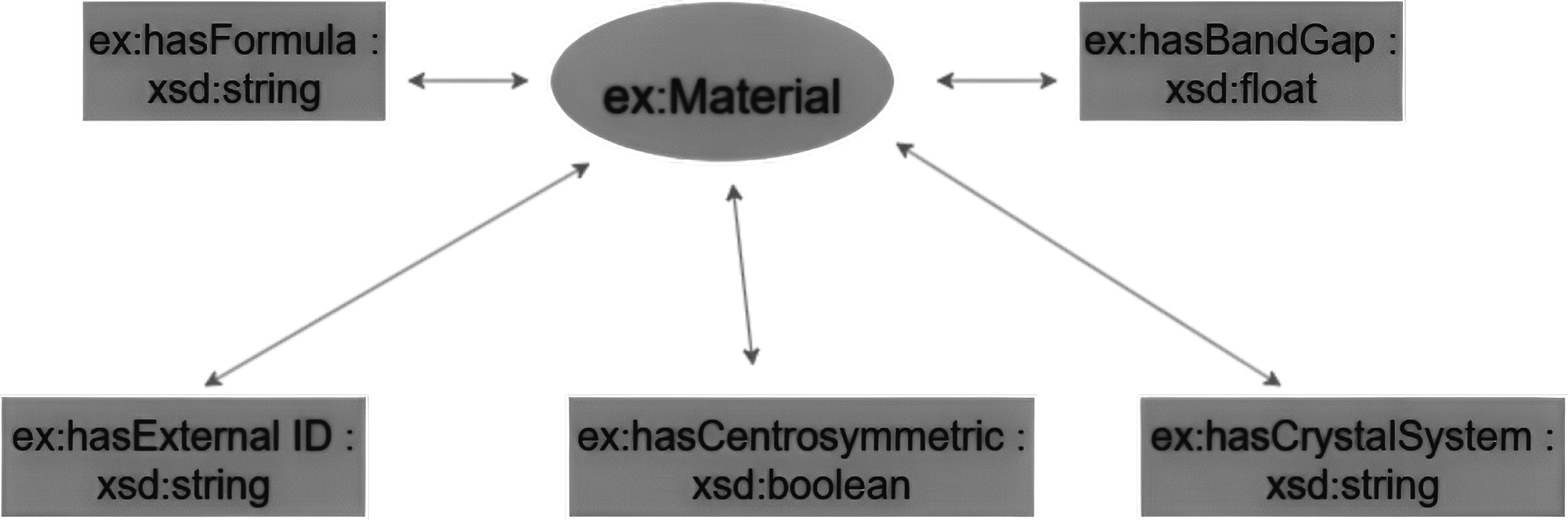
understood failure modes into corrected output. The RDF schema covers
composition, crystal system, centrosymmetry, band gap, and provenance
across 1.36M triples. Node identity is the Materials Project
material_id, not chemical formula: one composition
crystallises into structurally distinct phases, and 91.6% of multi-entry
compositions were confirmed to hold genuinely different structures via
pymatgen StructureMatcher.