Graphene Dirac Cone under Uniaxial Strain — DFT
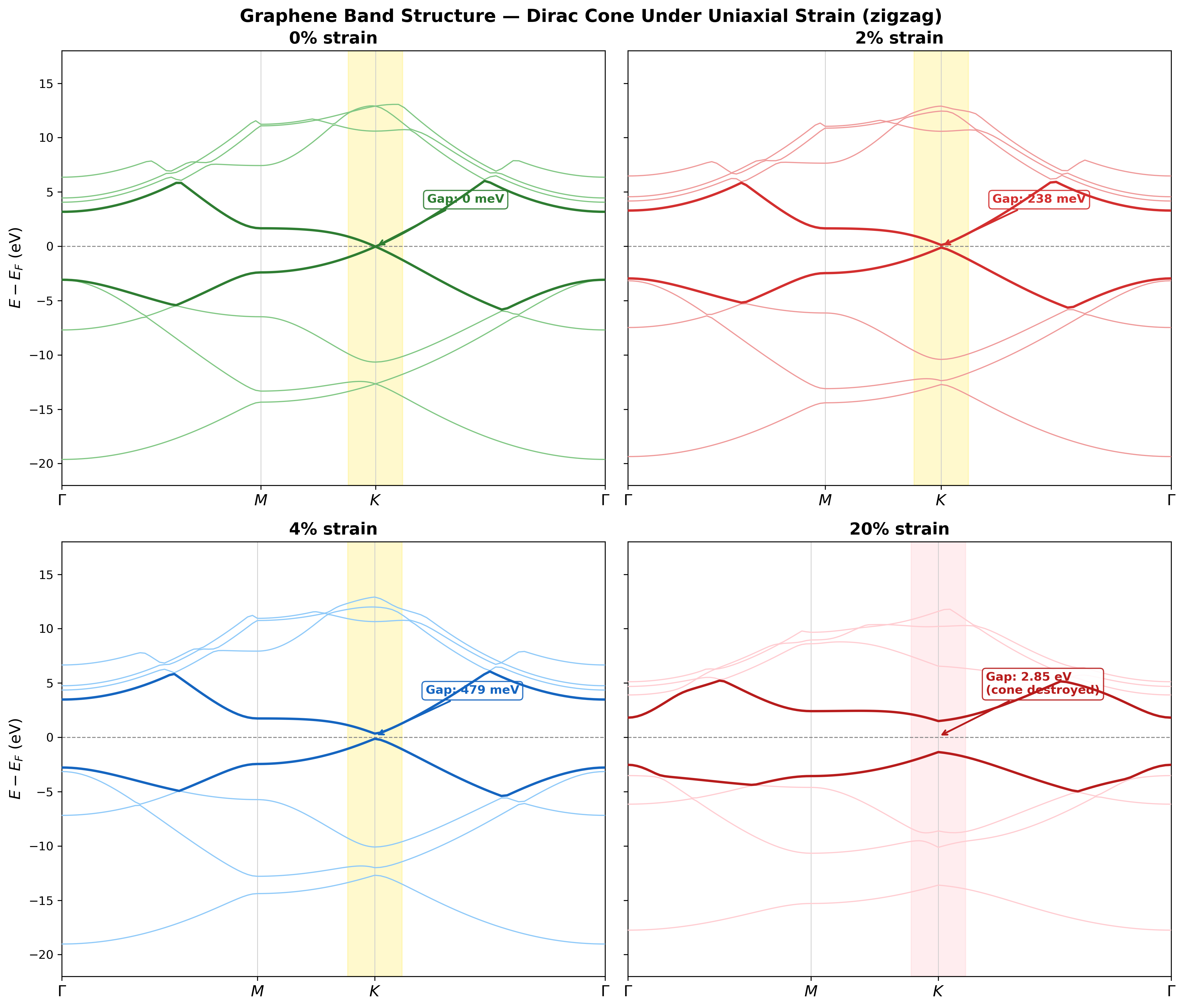
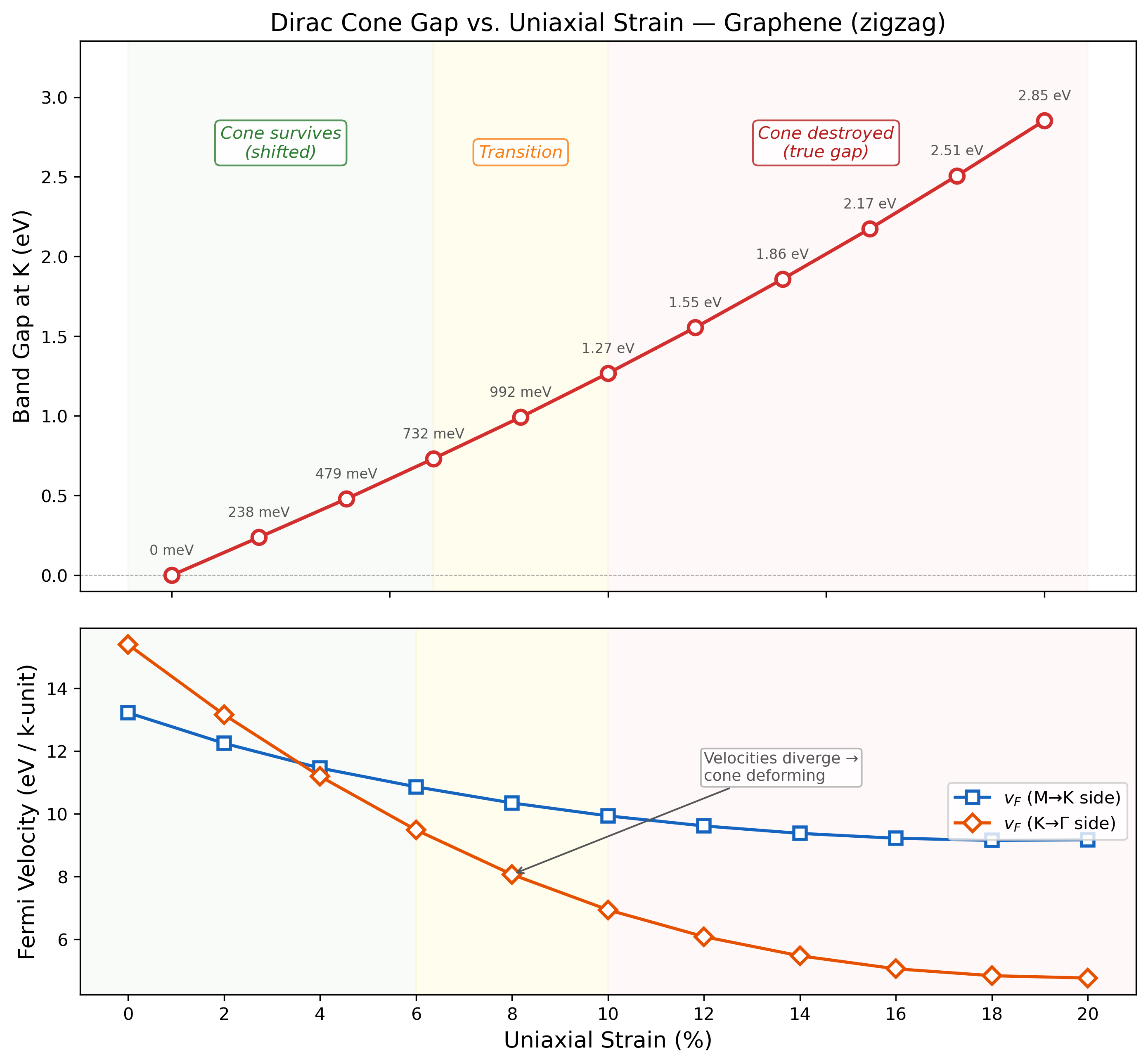
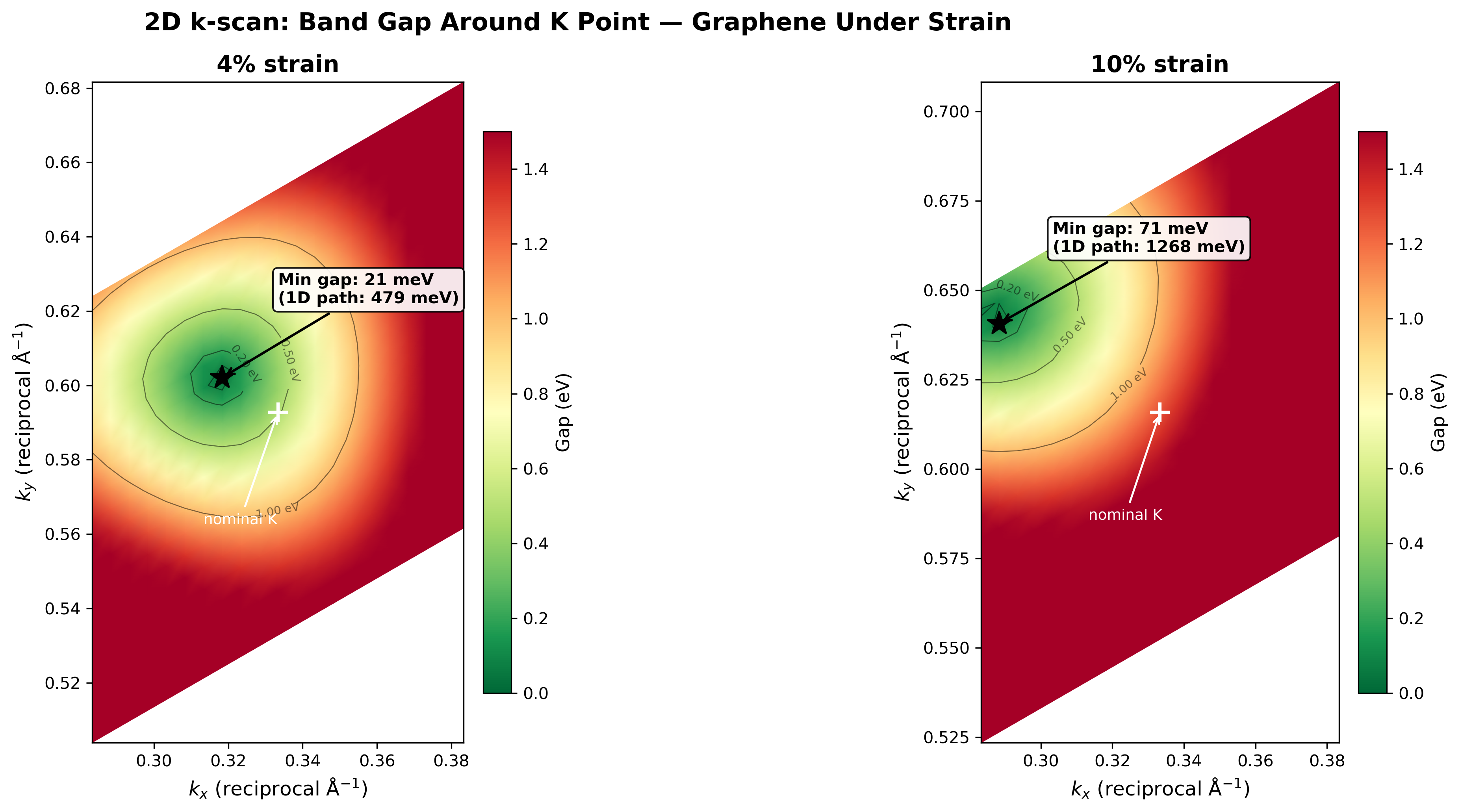
First-principles PBE study (Quantum ESPRESSO) of how the Dirac cone in graphene responds to uniaxial tensile strain along the zigzag direction, from 0% to 20% in 2% steps. The key methodological contribution: a 2D k-scan around the K point at selected strain levels revealed that the standard 1D band path overestimates the gap by 23× at 4% strain — the apparent 479 meV gap reduces to 21 meV once the actual (shifted) Dirac point is located. This makes the Fermi velocity asymmetry a practical diagnostic: the ratio of M→K to K→Γ band slopes tracks whether a gap is a geometric path artifact or a true topological transition. Three regimes emerge cleanly — cone survives (0–4%), cone deforming (6–10%), cone destroyed (>10%) — with the critical strain appearing lower than simple tight-binding predictions (~10% vs ~20%), attributed to DFT capturing bond-weakening and orbital rehybridization absent from the tight-binding model. Structural relaxation under each strained cell (BFGS, fixed cell) confirmed that sublattice shifts grow from ~0.001 to ~0.016 crystal units at 20%, making internal relaxation non-negligible at large deformation.